The coronavirus pandemic has demonstrated once again that the time is ripe for a new kind of architecture. An architecture that utilises high-performance materials with intelligent surfaces and, above all, mediates between contrasts and creates scope for flexibility rather than imposing boundaries. Key to this are floor plans that can respond flexibly to social change.
Text: Roland Pawlitschko
For years, while ‘Corona’ dominated the daily news, viruses, superspreader events and infection rates were the main topics. It was not immediately obvious that the pandemic was, to a large extent, a crisis with significant implications for architecture: How many people are allowed to be in a given space?
In the context of all these questions, it is worth taking a look at the history of the city, which is not facing a pandemic for the first time today. The Spanish flu alone claimed the lives of between 20 and 50 million people worldwide around 1920, depending on the estimate. The Bauhaus and classical modern architecture should be seen not least as a direct response to this. “Light, air and sun” were to be made accessible to as many people as possible in the shortest possible time. This led not only to the creation of standardised, healthy housing units made from prefabricated components, but also to the principle of the spatial separation of living and working – a principle still applied today in architecture and urban planning.
However, the functionally segregated city leads to long journeys and thus to high traffic volumes, with harmful levels of air pollution and particulate matter. It also increases land consumption and encourages the emergence of monotonous neighbourhoods. Last but not least, floor plans have emerged that offer just as little scope for the unexpected in homes and offices as they do in hospitals or the hotel industry. And this at a time when unpredictability has become the new normal.
Despite everything, the future of our built environment does not lie in a nightmare scenario of social distancing and spaces full of hand sanitiser stations, partition screens and strictly segregated movement flows. Rather, it lies in resilient, intelligent architecture. „Our architecture should […] possess the same characteristics as the virus: adaptable, mobile, scalable and resilient“, says Berlin-based architect Gustav Düsing in relation to his project for a mobile quarantine station.
“The virus stands still neither in space nor in time – we should base our architectural approach on these two conditions.” With regard to residential buildings, for example, this could mean in concrete terms: instead of a multitude of uniform floor plans tailored primarily to single people and small families, we need larger, multifunctional, flexible clusters. They allow for the changes that make the living environment worth living in even during a lockdown – whether through intergenerational contact with fellow residents or through integrated workspaces, workshops and communal areas. “ ‘Had we already responded, in terms of urban development and housing policy, to this societal transformation – not only of the world of work but also of lifestyles – we would have been better prepared architecturally for the coronavirus crisis and the lockdown,’ wrote the co-editor and editor-in-chief of the architecture magazine ‘ARCH+’, Anh-Linh Ngo, wrote last summer in the weekly newspaper “Die Zeit”. Essentially, we do not need new architecture; we simply need to implement and further develop those inclusive ideas that many building groups and co-operatives, as well as numerous progressive companies, have been putting into practice for years.
The global rise in urbanisation inevitably leads to greater urban density and, ultimately, to the very issues that have caused us so much trouble during the pandemic due to the close proximity of large numbers of people. However, the coronavirus will be just as unable to halt urbanisation as previous pandemics have been.
Instead, it is likely to act as a catalyst for the development of intelligent architectural solutions. Working from home and home schooling within the home, as well as contact restrictions and social distancing rules in the office, do not necessarily require entirely new floor plan configurations. Sometimes it is enough simply to improve the connection between rooms and their neighbours by adding extra doors, in order to facilitate changes in use or altered movement patterns when necessary. Simple measures such as these lead – even without a pandemic – to multifunctional spaces and buildings, and consequently to multifunctional and liveable cities.
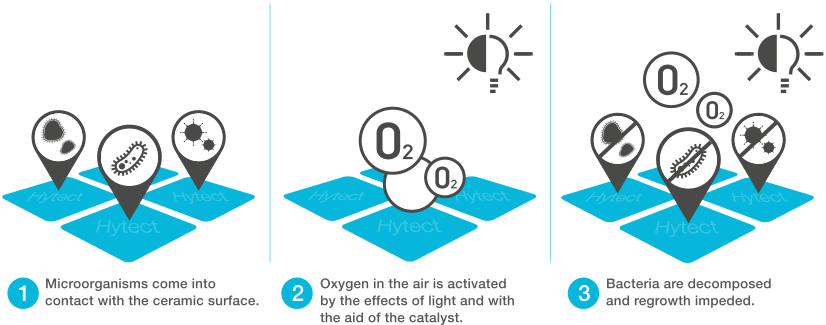
In the Hytect surface treatment used by Agrob Buchtal, the antimicrobial effect is achieved through a form of titanium dioxide that has been specially developed for this application. It is applied at high temperatures during the ceramic manufacturing process and fuses inseparably and permanently with the material – unlike most other building materials with such coatings, the titanium dioxide is bound within a closed surface structure. The effectiveness, confirmed by several ISO certificates, is multifaceted. Firstly, Hytect ceramic, in combination with light and oxygen, naturally releases active oxygen, which inhibits the growth of mould, viruses and bacteria directly on the surface. At the same time, water forms a wafer-thin film on this ceramic, which washes away dirt and grease, making these tiles extremely easy to clean. Finally, the ceramic activates natural processes to purify the air, for example by removing nitrogen oxides and odours. All these properties make the material the ideal building material for both weather-exposed building envelopes and a wide variety of interior spaces. Hygienic, easy-to-clean ceramic surfaces are by no means required only in kitchens, bathrooms, swimming pools and hospitals. They are also in demand wherever large numbers of people frequently gather: in the public areas of offices, schools and government buildings, as well as in restaurants, hotels and museums.
In the Hytect surface treatment used by Agrob Buchtal, the antimicrobial effect is achieved through a form of titanium dioxide that has been specially developed for this application. It is applied during the ceramic manufacturing process at high temperatures and fuses inseparably and permanently with the material – unlike most other building materials with such coatings, the titanium dioxide is bound within a closed surface structure. Its effectiveness, confirmed by several ISO certifications, is multifaceted. For one thing, Hytect ceramic, in interaction with light and oxygen, naturally releases active oxygen, which inhibits the growth of mold, viruses, and bacteria directly on the surface. At the same time, water forms an ultra-thin film on this ceramic that prevents dirt and grease from adhering, making these tiles extremely easy to clean. And finally, the ceramic activates natural processes to purify the air, for example by removing nitrogen oxides and odors. All these properties make the material an ideal building material for both weather-exposed building exteriors and a wide variety of interior spaces. Hygienic, easy-to-clean ceramic surfaces are by no means used only in kitchens, bathrooms, swimming pools, and hospitals. They are also in demand wherever large numbers of people frequently gather: in the public areas of offices, schools, and government buildings, as well as in restaurants, hotels, and museums.
The effects of titanium dioxide coatings on the coronavirus have not yet been conclusively investigated scientifically. What is certain, however, is that such smart material solutions, combined with holistic architecture, are already helping to develop more flexible and resilient concepts – regardless of the intended use. Regardless of this, we will probably have no choice but to break away from the modern model of functional separation in our cities and buildings – which is now over a hundred years old – as well as from one-dimensional thinking regarding our ways of life. Instead, this should be replaced by an interdisciplinary, interconnected world of cycles, which – by providing greater scope for manoeuvre – not only helps us deal with pandemics but also strengthens society as a whole. This approach is not new, but now – particularly in light of climate change – there is one more compelling reason to actually put it into practice.